

Students Alex Torrealba, Salma Wennekers and Cynthia Wang (photos by May Truong)
Article by Sharon Aschaiek originally appeared in U of T Magazine, Winter 2026
For many students, the path to a U of T degree is shaped as much by circumstance as by ambition. Financial support can mean the difference between simply getting by and fully engaging in campus life. Here, five U of T students reflect on how scholarships and grants have changed what they’re able to pursue and accomplish during their time at the university.
Abdul Rauf Hasanyar
Recipient: Lester B. Pearson International Scholarship
Program: Computer science (co-operative)
Campus: U of T Scarborough

Receiving a full-ride Pearson Scholarship made it possible for Abdul Rauf Hasanyar to attend U of T, but his journey began far from campus.
Hasanyar grew up in a small village in southeastern Afghanistan, tending animals on his parents’ subsistence farm. As members of the minority Hazara community, his family faced persistent discrimination, he says. When Hasanyar later moved to Kabul, that hatred turned deadly: in April 2022, militants bombed his high school, killing some of his friends. His parents viewed a university education abroad as a way out of bigotry and poverty.
“My parents have suffered a lot in their life because of their lack of education,” Hasanyar says. “They always encouraged me to study, even in the toughest times.”
At age 12, he began taking after-school English classes and soon became skilled enough to teach other children. In high school, he discovered an aptitude for math and was drawn to computer coding. Now studying at UTSC, Hasanyar enjoys working in Python and has become involved in the Hazara Student Association at the St. George campus.
“Quality education was always a dream for me,” he says, adding that he hopes one day to start a technology company that enhances access to education or internet service in rural Afghanistan. “I’m interested in improving opportunities for people in my home country.”
For me, financial support has been… Life-changing
Favourite study spot: UTSC Library
Future plans: Postgraduate studies
In 2023-24, U of T provided $114 million to international students – through need- and merit-based awards and scholarships. Almost all U of T student funding is non-repayable.
Cynthia Wang
Recipient: Lester and Jean Gagnon Summer Student Scholarship
Program: Doctor of Medicine
Campus: St. George

A summer scholarship clarified for Cynthia Wang not only what kind of doctor she wants to be – but how she wants to practice.
Following her second year in U of T’s MD program, Wang received a $4,000 Gagnon Summer Student Scholarship for an immersive seven-week summer experience in family medicine.
“There’s a perception that the demand on family physicians is overwhelming,” says Wang. “This scholarship helped me realize work-life balance is possible.”
The program included time at Collingwood General and Marine Hospital, Toronto Western Hospital’s family health team and a community health clinic in North York. Across the three placements, Wang learned more about rural medicine, gained hands-on experience with a variety of procedures and observed the tight bonds family doctors build with their patients.
“I saw how much patients trusted their doctor,” she says. “I found that really powerful.”
Wang also attended lectures and workshops on communicating with patients, collaborating with health professionals and managing the administrative and financial sides of a medical practice.
Now applying to U of T’s Family Medicine Residency Program, Wang sees family medicine as a place where she can form meaningful, long-term connections with patients.
For me, financial support has been… Validating
Favourite study spot: Gerstein Library
Hidden campus gem: The sakura trees next to Robarts Library
U of T’s academic divisions provided $65 million in assistance to graduate and undergraduate students in 2023-24. The university centrally supported student work and research experiences that year with $12 million.
Alex Torrealba
Recipient: C. David Naylor University Fellowship
Program: Master of Environment and Sustainability
Campus: St. George
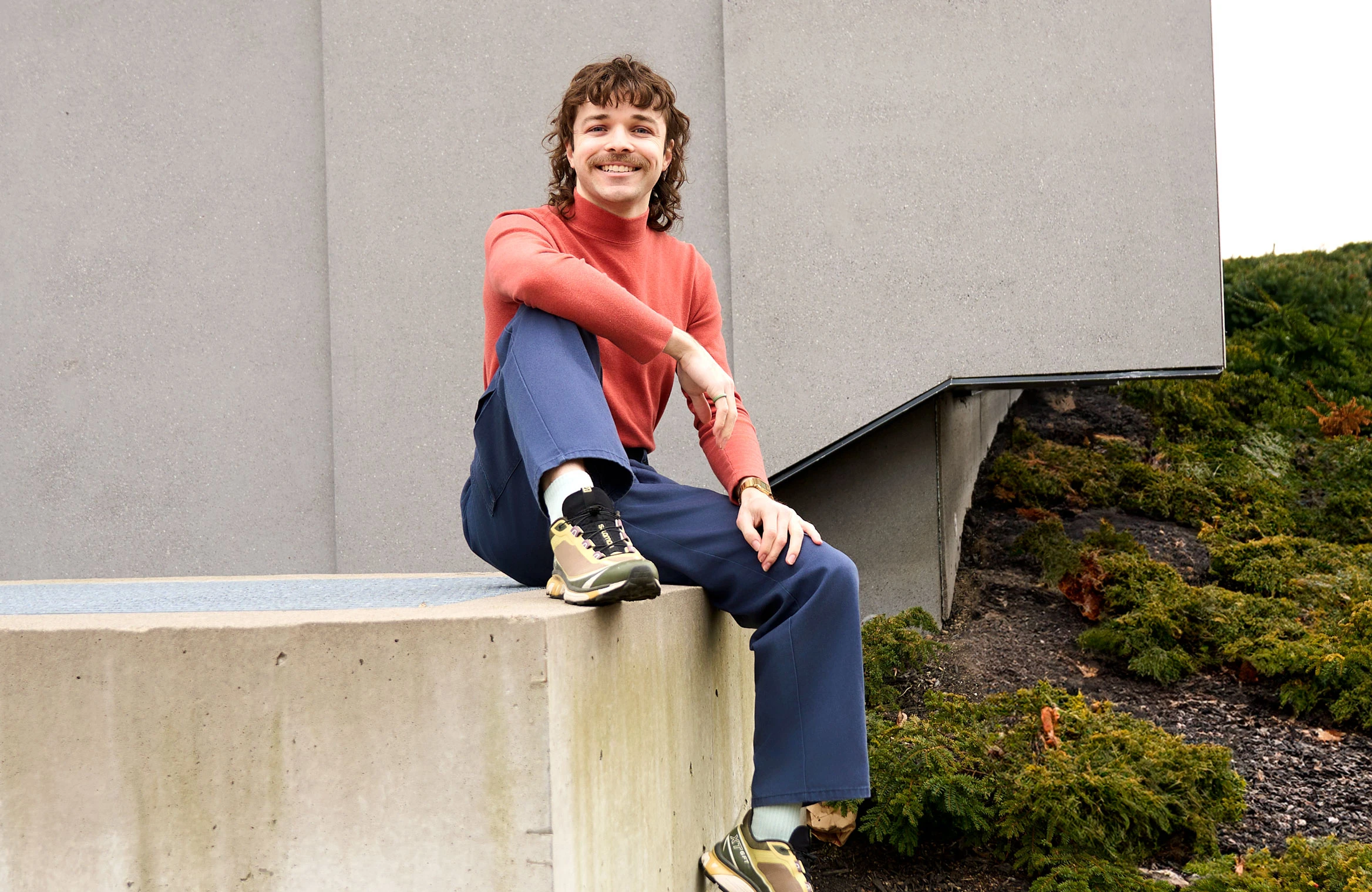
For Alex Torrealba, the value of financial support is measured in focus.
The $30,000 Naylor Fellowship – awarded annually to two academically strong graduate students from Atlantic Canada – has allowed Torrealba to fully commit to his climate research.
In their 12-month master’s program, they are exploring how changes in wind patterns due to climate change could reshape wind-energy potential across Canada.
“Having the stability of this funding is really valuable,” says Torrealba, who grew up in Nova Scotia. “It’s given me so much more time to focus on my studies.”
After completing a bachelor of science at Dalhousie University, Torrealba came to U of T to work with atmospheric scientist Debra Wunch. He values both Wunch’s mentorship and the diversity of the master’s program, which includes students from a wide range of academic backgrounds.
By analyzing global climate models, Torrealba hopes to better understand what the future of a sustainable energy system might look like. “As we transition towards a sustainable economy, how can we be more forward-thinking in the way we design and place wind turbines?”
For me, financial support has meant… Stability
Favourite study spot: My office or the UC Library
Hidden campus gem: The Donelly building’s bamboo forest
Students in research-stream master’s and doctoral programs received $412 million in funding in 2023-24 through various sources, including research stipends, University of Toronto Fellowships, merit-based awards and bursaries. This support enhances access to advanced study and research.
Salma Wennekers
Recipient: National Scholarship
Program: Drama and English
Campus: St. George

Salma Wennekers is fascinated by how performance shapes human behaviour – on stage and off.
That curiosity was reignited in a recent class examining how 1980s queer subcultures – from drag shows to gender-bending personas – have influenced mainstream theatre. “How do these concepts of performativity infect everything we do,” she wonders, “and in every area of our lives?”
At her Mississauga high school, Wennekers wrote, directed and performed in two plays that earned nine National Theatre School provincial awards. Raised by a single mother with four siblings at home, she says the question was never whether she would go to university, but how she would afford it. “I thought the only possible way was to get a loan,” she says.
A National Scholarship from U of T covered her tuition and residence, lifting that uncertainty. “I got to start thinking about which courses to take,” she says, “not how to pay for everything.”
At U of T, Wennekers gravitated toward set design, stage management and costume design. Her production of BUTCH/FEMME, a contemporary exploration of lesbian love, won best production at the 2025 Hart House U of T Drama Festival and went on to a one-week run at Theatre Passe Muraille.
As she considers a master’s degree, Wennekers hopes to contribute her own insights into how performance and everyday life intersect.
For me, financial support has meant… Solace
Favourite U of T study spot: Café Reznikoff
Proudest moment in the past year: Opening a professional play
Velislav Dzhebarov
Recipient: Nancy Salmon Scholarship, University of Toronto Scholar Award
Program: Biology for Health Sciences
Campus: U of T Mississauga

“Finances have always been tight,” says Velislav Dzhebarov, who was raised by a single mother. “There’s always that thought in the back of your head about whether you can afford to do something.”
U of T financial support eliminated that burden and allowed Dzhebarov to fully engage in campus life. Instead of working part-time to make ends meet, he was able to focus on volunteering, leadership and research.
For three years, he helped oversee the UTM Pre-Dental Club. He also shadowed a local dentist and volunteered at a community food bank and soup kitchen. During the school year, instead of having to work, he participated in research projects investigating glutamate receptors, which are crucial to brain function and the central nervous system.
Now applying to dentistry programs across Canada, Dzhebarov says those extracurricular experiences greatly enriched his education: “Not worrying about finances opened up countless doors for me.”
For me, financial support has been… Empowering
Favourite U of T study spot: UTM Library
Future plans: Pursue dentistry
U of T provided $108 million in need-based awards in 2023-24, helping students manage financial pressures while pursuing their degrees.
EXCELLENCE, WITHOUT BARRIERS
At a time when affordability remains a central concern for students and families, U of T has reaffirmed its longstanding policy that no domestic student offered admission should be unable to enter or complete their program due to lack of financial means.
To meet this commitment for more than 100,000 students, U of T’s investment in financial aid has increased steadily – with $380 million allocated in 2024-25, more than double the amount provided a decade ago.
Philanthropy has assisted in that growth. Since the launch of the Defy Gravity campaign in 2019, donors have contributed more than $339 million toward student support, strengthening U of T’s capacity to pair top-tier research and teaching with broad financial accessibility – an increasingly rare combination among its global peers.
BY THE NUMBERS
- $380 million earmarked for student financial support in 2024–25, up 15 per cent from the year before
- $4,307 in institutional scholarships and bursaries per full-time equivalent student in 2024–25 – 73 per cent higher than the Ontario average
- $40,000 minimum annual funding package for qualifying PhD students, among the highest in Canada
- 16,000+ donors have supported student awards through the Defy Gravity campaign
Back to News & Celebrates